How to Promote Health Supplements as an Affiliate Without Violating FTC or FDA Rules
Here’s how to promote health supplements as an affiliate without violating FTC or FDA rules: stick to the claims the product’s label is allowed to make, never say a supplement treats, cures or prevents a disease, and have real evidence behind anything you say about results. Put a plain-English commission disclosure right next to your recommendation, and build on channels you control: a blog that answers specific questions and an opt-in email list.
That’s the short version. Here’s the part most people skip.
I read the top results for this search before I sat down to write. They all say the same handful of things. Start a blog. Make some YouTube videos. Build an email list. Niche down. Disclose. All true, and all a little bit like telling a new driver to “follow the rules of the road” without mentioning which side of the road.
What almost none of them show you is what a compliant sentence actually looks like, or why the most dangerous thing on your page is often something you copied from the merchant.
I’ve been selling health products as an affiliate for a long time (I reached Super Affiliate status with Sell Health), so I’m not going to pretend I’m neutral about any of this. If you haven’t picked a program yet, start with my short list of beginner-friendly supplement affiliate programs. This post is about what you do after you’re approved.
One more thing up front. I’m not a lawyer, and this isn’t legal advice. It’s what the agencies say on their own pages, plus how I apply it.
The two rulebooks, in plain English
The FDA mostly worries about what’s on the label. Under DSHEA (the 1994 supplement law), a supplement can make structure/function claims. The FDA’s own examples are “calcium builds strong bones” and “fiber maintains bowel regularity.” Only a drug can legally claim to diagnose, treat, cure or prevent a disease. Those claims aren’t pre-approved, either. The manufacturer has to have substantiation and notify the FDA within 30 days of marketing the product with the claim.
The FTC worries about advertising. That’s you. Its Health Products Compliance Guidance says ads must be truthful, and that health claims need “competent and reliable scientific evidence,” generally randomized, controlled human clinical testing. It also says “anyone participating in deceptive marketing is potentially liable.” Affiliates included.
And that little “These statements have not been evaluated by the Food and Drug Administration” line? The same FTC guidance says it “won’t cure an otherwise deceptive ad.” It’s a label requirement. It is not a force field.
How to promote health supplements as an affiliate: 7 steps
1. Pick products you’d be willing to defend
Start here, because no amount of careful wording fixes a bad product. The FDA says it has found over a thousand products marketed as supplements or foods with hidden drugs in them, typically sold for sexual enhancement, weight loss, bodybuilding, joint pain, diabetes and sleep. One of its red flags is a sexual enhancement product claiming to work “in 30 minutes.” Before you promote anything, search the FDA Health Fraud Product Database. The FDA itself says a product missing from that list isn’t proof it’s safe, so read the Supplement Facts panel too. If you can’t tell what’s in the bottle, neither can your reader.
2. Build a claim sheet from the label, then don’t upgrade it
Copy the structure/function statements from the product’s label and official page into a plain text file. That’s your ceiling. If the label says “supports restful sleep,” you don’t get to write “fixes insomnia.” Insomnia is a condition. Now you’re making a drug claim on a product that isn’t a drug.
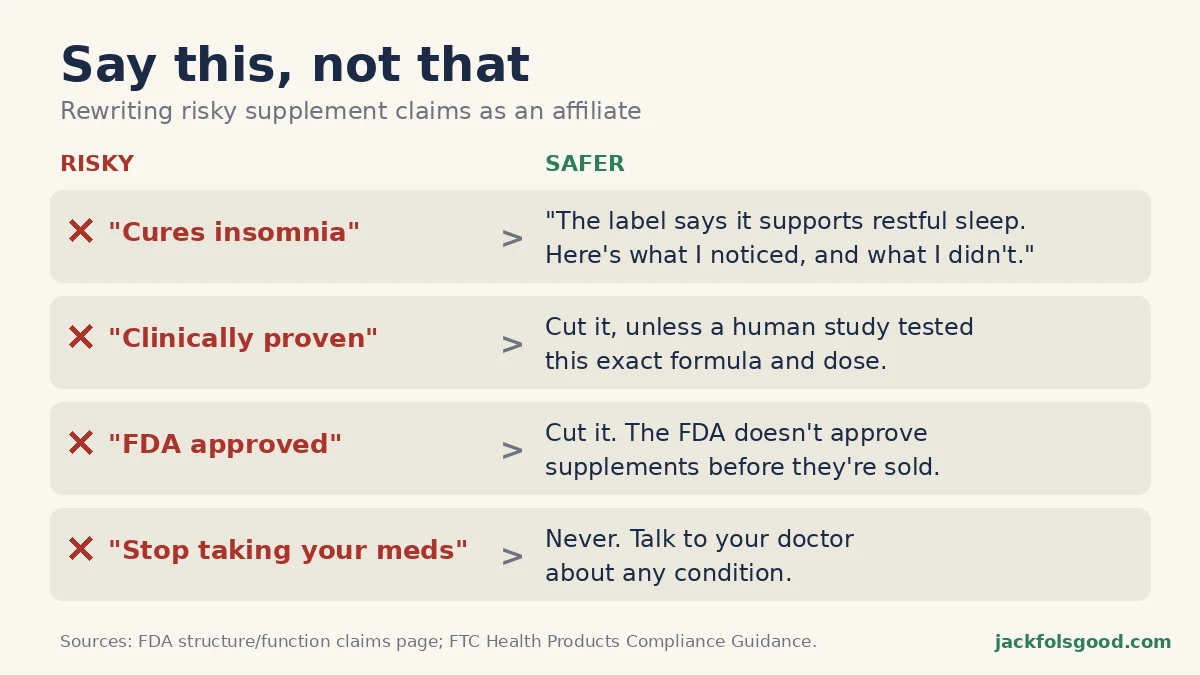
Here’s how I rewrite the usual offenders:
- “Cures insomnia” becomes “The label says it supports restful sleep. Here’s what I noticed, and what I didn’t.”
- “Clinically proven” gets cut, unless a study tested that exact formula and dose in people like your reader. A study on one ingredient isn’t a study on the product.
- “FDA approved” gets cut. The FDA doesn’t approve supplements before they’re sold.
- “You can stop taking your meds” never gets written. Ever. Send people to their doctor instead.
Keep the claim sheet. If anyone ever asks where a statement came from, you’ll have the answer in about ten seconds.
3. Watch the claims you didn’t mean to make
The FTC looks at claims made “expressly or by implication.” So a headline like “I Threw Out My Blood Pressure Pills” is a claim, even if the paragraph under it is careful. So is a before-and-after photo. So is that glowing reader comment you pinned to the top.
Testimonials are the big trap. The FTC guidance says you can’t use a testimonial to say something you couldn’t back up yourself. And its Endorsement Guides FAQ says “Results not typical” or “Individual results may vary” won’t change how people read a dramatic result. If the merchant’s swipe copy is full of miracle stories, leave it in the swipe file.
4. Disclose like a human, close to the link
The same FAQ says a disclosure is more likely to be seen if it’s very close to the endorsement, and that “affiliate link” by itself may not be understood. A “buy now” button doesn’t count either. Use real words, something like “I get commissions for purchases made through links in this post.” Put it near your first recommendation, not in the footer where nobody goes.
5. Write content that doesn’t need big claims to sell
The pages that hold up best are ingredient explainers that link to their sources, comparisons on price, dose, subscription terms and refund policy, and honest “what I noticed after a month” reviews that say what didn’t happen, too. None of those need a miracle to work. I’m not saying it’s glamorous. It’s the same reason I keep telling people to stop trying to game the big G; my take on whether SEO still works explains why junk pages are a short-term plan.
6. Use email, but only with people who asked for it
Email is a good channel for this stuff. It’s also where people get sloppy. Some programs restrict it outright; the NutriProfits FAQ, for example, only allows email promotion to people who agreed to receive marketing from you. The FTC’s CAN-SPAM compliance guide adds the rest: a valid physical postal address in every marketing email, an opt-out you honor within 10 business days, and penalties of up to $53,088 per violating email. It also says both the company whose product is promoted and the sender can be held responsible. Every claim rule above applies inside your emails too.
7. On video and social, say it out loud
If you review supplements on YouTube, the Endorsement Guides FAQ says to disclose the affiliate relationship in the video itself, not only next to the link in the description. It also says a platform’s built-in disclosure tool isn’t necessarily enough on its own. Most platforms also have their own rules for supplement and weight-loss content, so read them before you build there.
Where Sell Health fits
Quick, honest note before the link: the Sell Health link below is my affiliate link. If you sign up through it, I earn a commission, and it costs you nothing extra. You can read my full affiliate disclosure page for the details.
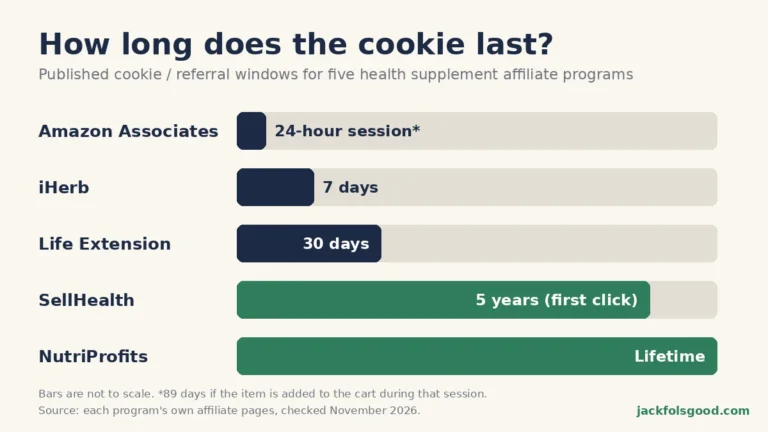
Sell Health is the program I use, so weigh my opinion accordingly. If you want to look it over, here’s my Sell Health affiliate sign-up link. Fair warning: I rate it medium risk for a beginner. Approval is manual, these are products where claims get looked at hard, and in September 2026 one affiliate posted on Reddit that a payout was frozen after a compliance hold. One post, unverified. Still, that’s the whole point of this article. Keep your claims clean and you give a merchant fewer reasons to hold your money. My updated Sell Health review has the commission, cookie and payout details.
Pre-publish checklist
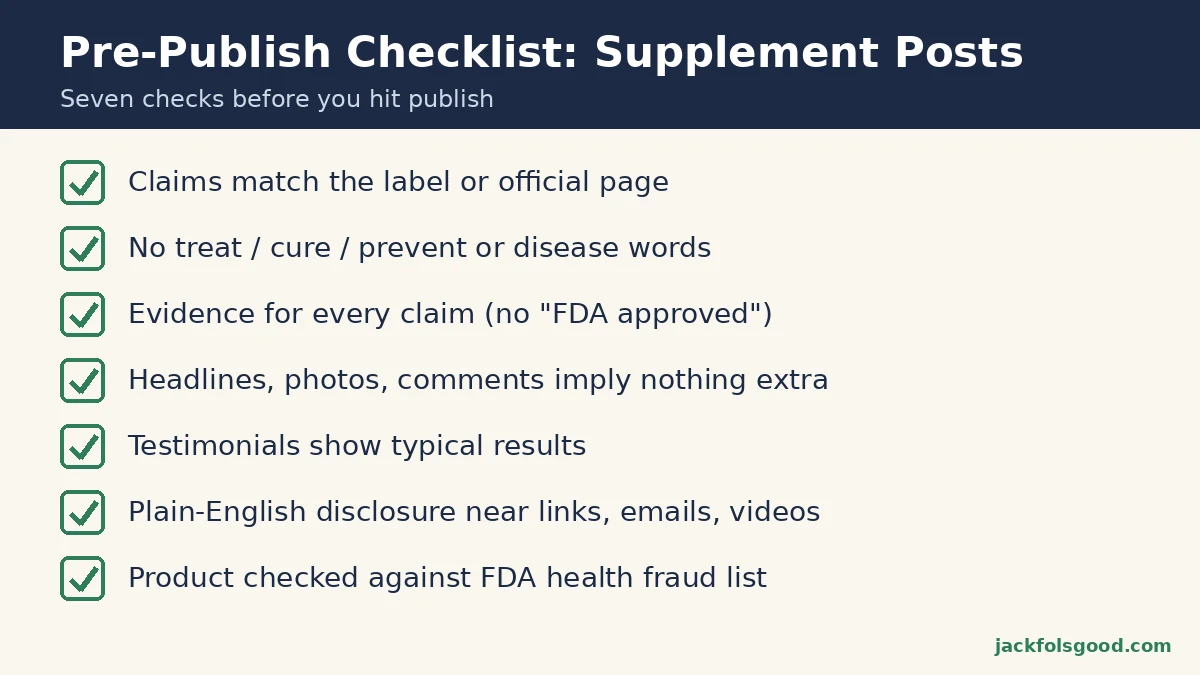
- Every health claim on the page also appears on the product’s label or official page.
- No “treats,” “cures,” “prevents,” “reverses” or disease names attached to the product.
- No “clinically proven” without a study of that exact product, and no “FDA approved.”
- Headlines, images and pinned comments don’t imply what the text won’t say.
- Testimonials reflect typical results, or they’re gone.
- A plain-English disclosure sits near the first affiliate link, and in every email and video.
- The product isn’t in the FDA Health Fraud Product Database, and the label lists every ingredient.
FAQs
Can I say a supplement “supports” something?
Yes, if the product’s label makes that structure/function claim and the evidence backs it. “Supports restful sleep” can be fine. “Treats insomnia” is a disease claim, and only a drug can legally make one.
Does the FDA disclaimer protect me as an affiliate?
No. The “not evaluated by the Food and Drug Administration” line is a label requirement. The FTC says it won’t cure an otherwise deceptive ad, so a bad claim stays a bad claim with or without it.
Can I share customer testimonials or my own results?
Carefully. A testimonial can’t claim anything you couldn’t back up yourself, and “results may vary” doesn’t fix a dramatic, untypical result. Share your honest experience, including what didn’t happen.
Do I need to disclose affiliate links in emails and videos?
Yes. Disclose in every email that carries affiliate links and say it out loud in the video itself, not just in the description. The FTC wants the disclosure close to the recommendation and easy to understand.
Can I call a supplement “clinically proven” or “FDA approved”?
Not “FDA approved”; the FDA doesn’t approve supplements before they’re sold. “Clinically proven” needs solid human studies of that exact formula and dose. If you can’t point to them, leave it out.
None of this is hard. It’s just boring, and boring is what keeps a commission check coming. As I said in my post on finding an easier way to make affiliate commissions, it comes down to finding something that works and doing it over and over. You’ll find more like this in my Internet Marketing archive.
So what’s the one claim on your site you’re going to go fix tonight?
Good luck out there,
Jack