Best Health Supplement Affiliate Programs for Beginners (Without Shady Networks)
The best health supplement affiliate programs for beginners are the ones that publish their terms where you can read them: SellHealth, NutriProfits, iHerb, Life Extension and Amazon Associates. Start with one high-commission in-house program and one mainstream retailer, and learn the FTC and FDA claim rules before you write a single review.
That’s the short answer. The long answer is a little bit messier.
I read the top results for this search before writing this. Most of them are long lists. Twenty programs, twenty-five programs… and a few of them are already out of date (more on that further down). Almost none of them tell a beginner what actually gets you in trouble with supplements. Hint: it’s not which program you pick. It’s what you say about the product.
I’ve been selling health products as an affiliate for a long time. I reached Super Affiliate status with Sell Health and I work from home, so I’m not going to pretend I’m neutral here. If you want my full head-to-head, read my Sell Health vs Market Health review. This post is the beginner’s short list. Different job.
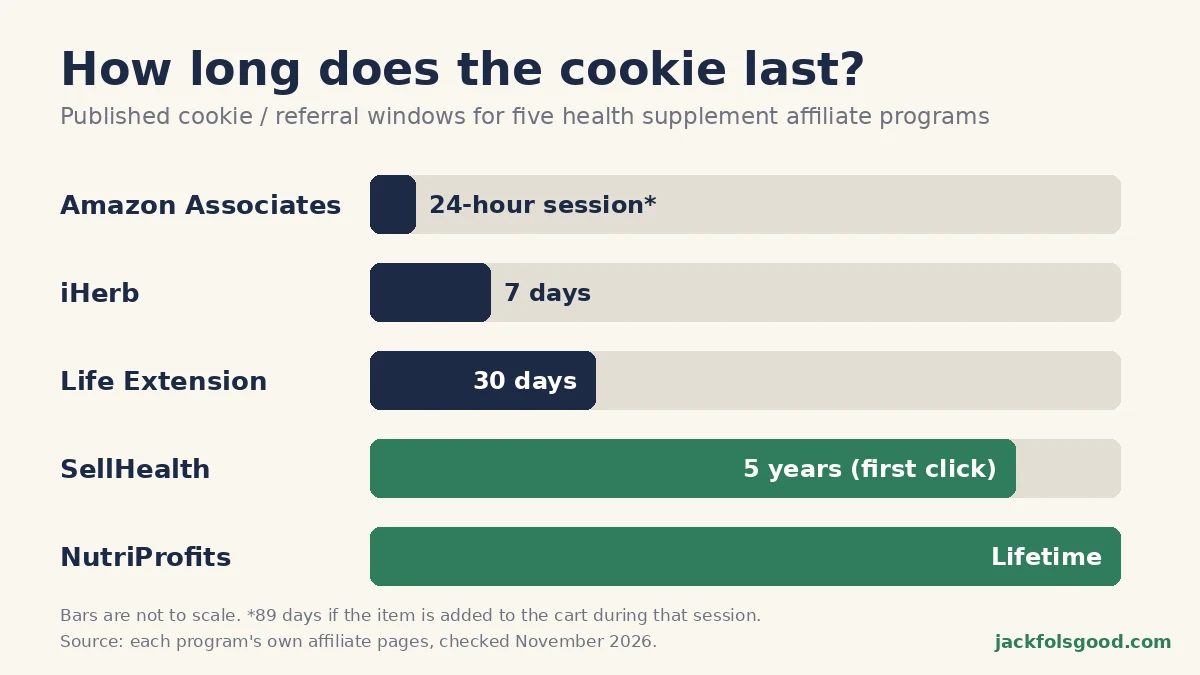
What “beginner-friendly” actually means
Forget the commission percentage for a second. A big number on a sign-up page doesn’t mean much if the cookie expires before your reader gets around to buying.
- Cookie length. How long after a click you still get credit.
- Minimum payout. A $100.00 threshold is a long wait when you’re starting from zero.
- Who runs it. In-house means the merchant tracks the sale and pays you directly. A network (CJ, Impact, Awin, Partnerize) sits in the middle and handles tracking and payment.
- Approval bar. Some programs want a “content-rich website” before they’ll even look at you.
In-house programs like SellHealth and NutriProfits tend to pay more and track longer. Networks pay less but give you one dashboard, and a company in the middle if something goes sideways. Neither is shady by default. The shady ones are usually the programs that won’t publish their terms at all.
The short list, with the numbers they publish
Every number below comes from the program’s own pages, checked in November 2026. Programs change their terms (constantly), so check again before you sign anything.
Quick, honest note before the links: the Sell Health and Amazon links on this page are my affiliate links. If you sign up or buy through them, I earn a commission, and it costs you nothing extra. As an Amazon Associate, Jack Folsgood earns from qualifying purchases. The other programs are plain links. I don’t have accounts with them.
| Program | Commission | Cookie | Minimum payout |
|---|---|---|---|
| SellHealth | 30%–50% | 5 years, first click | $50.00 (PayPal, Wise, US ACH) |
| NutriProfits | Up to 40%; up to 20% on reorders | Lifetime | EUR 100 / GBP 80 / USD 100 |
| iHerb | Up to 25% | 7 days, last click | Set by your network |
| Life Extension | 6% | 30 days | Paid monthly via CJ |
| Amazon Associates | 1% (Health & Personal Care) | 24 hours (89 days if carted) | $10.00 direct deposit |
My picks, in order
1. SellHealth (Leading Edge Health)
This is the one I use, so take my ranking with the grain of salt it deserves. SellHealth’s FAQ says 30% to 50% per sale, with 40% once you show consistent daily sales and 50% for higher volume. The homepage banner says “up to 60%.” The FAQ doesn’t. I go by the FAQ.
The tracking is the real selling point for a beginner. Their tracking article describes a five-year, first-click cookie, plus credit on reorders, upsells and phone orders. According to their payout page, they pay twice a month (the 10th and the 25th) with a $50.00 minimum for PayPal, Wise or US ACH.
The catch? Approval is manual, and these are products where claims get looked at hard. In September 2026 one affiliate posted on Reddit that a payout was frozen after a compliance hold. One post, unverified. Still worth reading, and still a good reason to keep your claims clean.
If you want to look it over, here’s my SellHealth affiliate sign-up link.
2. NutriProfits
NutriProfits is the in-house program I’d look at second. Their FAQ lists up to 40% per sale, up to 20% on returning-customer orders, and lifetime cookie tracking.
Two things nobody puts on the banner. The minimum withdrawal is EUR 100, GBP 80 or USD 100, paid monthly by the 21st (bank transfer, Payoneer, Capitalist or crypto). And if a customer cancels, the commission comes back off your balance. Normal stuff. They also say email promotion is only allowed to people who agreed to hear from you.
3. iHerb
iHerb is the mainstream, low-drama pick. Their affiliate page says up to 25% commission, deep links to any product, and credit on whatever ends up in the cart.
Now the part a lot of lists skip. The cookie is 7 days, last click, and another affiliate’s link or a Rewards code can overwrite it. Payment comes about 45 days after the month closes, through whichever network you join (Partnerize, Impact, CJ or Awin). They also want “a digital presence that can use link tracking.” Fine for a blog. Not so fine for a guy with a Facebook page and big dreams.
4. Life Extension
Life Extension is the boring one. That’s a compliment. Their affiliate page says 6% on all web sales and a 30-day referral period, run through Commission Junction with monthly payments. They’re looking for “a content-rich website,” so treat this as a month-two application, not a day-one.
5. Amazon Associates
Amazon pays 1% on Health & Personal Care, per its commission schedule. One percent. The operating agreement gives you a 24-hour session, or 89 days if the item goes into the cart during that window. Payouts start at $10.00 by direct deposit.
I’m not saying that’s worthless. People already trust the checkout, and you get credit on the other stuff they buy. But for a beginner, Amazon earns its spot with books and gear around your niche, not the bottles. If you’re brand new, a plain-English affiliate marketing book for beginners is a better first purchase than another tub of protein.
Programs I left off, and why most lists are stale
BulkSupplements shows up on a lot of these lists as an Awin program. Their own affiliate page now says the program moved to TikTok Shop and Awin links no longer earn commission. Thorne’s affiliate page is a professional account platform for licensed practitioners, not something a new blogger joins.
That’s why every number above came from the merchant, not from somebody else’s roundup. Including this one. Check it yourself.
The FTC and FDA stuff nobody puts in the roundup
This is where supplement affiliates actually get burned.
The FTC’s Health Products Compliance Guidance says health claims need “competent and reliable scientific evidence,” and that anyone participating in deceptive marketing is potentially liable. That means you, the affiliate. Not just the company that makes the pills.
On the FDA side, a supplement can make structure/function claims (their example: “calcium builds strong bones”). Only a drug can legally claim to diagnose, treat, cure or prevent a disease. And that little “not evaluated by the FDA” disclaimer won’t save a bad claim. The FTC guidance says that in plain words.
Then there’s disclosure. The FTC’s Endorsement Guides FAQ says a disclosure is more likely to be seen if it’s very close to the endorsement. Not buried at the bottom of the page. They suggest wording as simple as “I get commissions for purchases made through links in this post.”
So in practice: describe what the product is, what the label says it’s for, and what you actually know. Don’t write “cures,” “fixes” or “doctors hate this.” If you haven’t used it, say so.
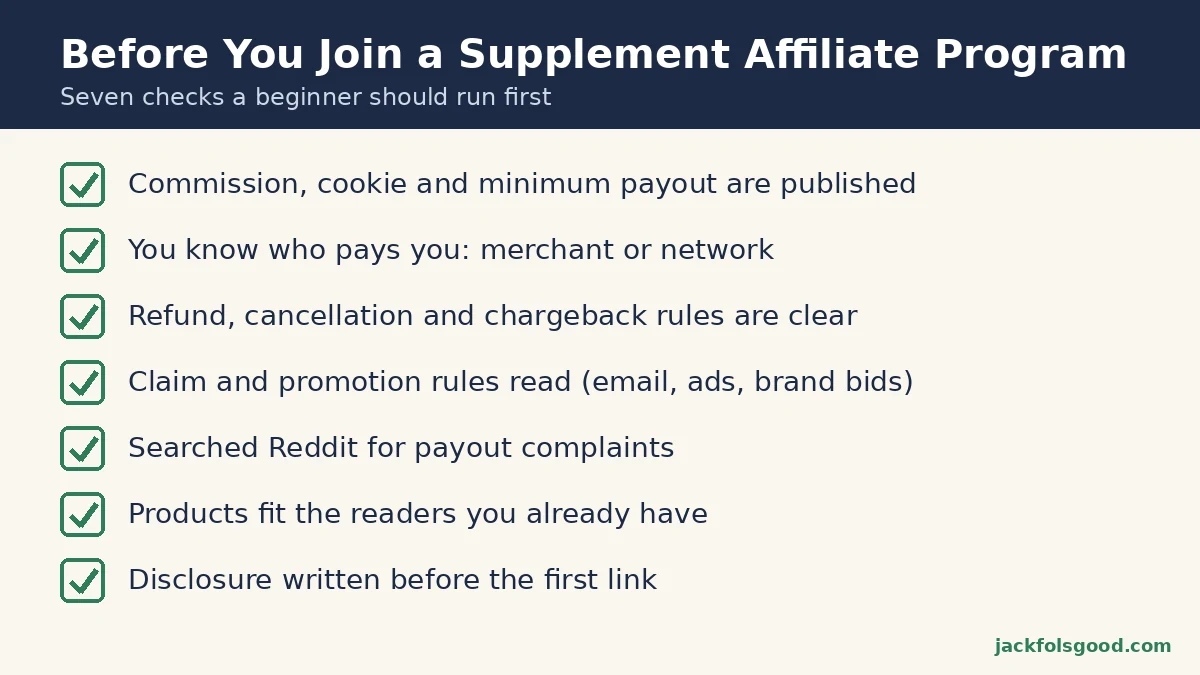
Before you join a supplement program: a checklist
- Find the commission, cookie and minimum payout on the program’s own page. No published terms, no deal.
- Check who pays you: the merchant directly, or a network.
- Read what happens to refunds, cancellations and chargebacks.
- Read the promotion rules (claims, email, paid ads, brand bidding).
- Search the program name plus “payout” on Reddit. One complaint is a data point, not a verdict.
- Make sure the products fit the people who already read your site.
- Have your disclosure written before you place the first link.
Where I’d start if I were brand new
Pick one in-house program and one mainstream retailer. Write honest content for one small corner of health, not “health.” Then do it again. As I said in Is There An (Easier) Way To Make Affiliate Commissions Online?, it comes down to finding something that works and doing it over and over.
Can the little guy still do this? I still think so, as long as you’re not trying to game the big G with junk pages. My Does SEO Still Work? post explains why that’s a short-term plan. You’ll find the programs I use on my Affiliates page.
FAQs
What is the best health supplement affiliate program for beginners?
There isn’t one winner. For a beginner I’d pair one in-house program with published terms, like SellHealth or NutriProfits, with a mainstream retailer like iHerb. Long cookies and clear payout rules matter more than the biggest percentage.
Do I need a website to join a supplement affiliate program?
Usually, yes. iHerb asks for a digital presence that can use link tracking, Life Extension wants a content-rich website, and SellHealth reviews applications by hand. A small, honest blog in one health niche is enough to start.
Is it legal to promote supplements as an affiliate?
Yes, if you follow the rules. Disclose your commissions near your links, back up health claims, and never say a supplement diagnoses, treats, cures or prevents a disease. The FTC says affiliates can be liable for deceptive claims too.
How much does Amazon pay on supplements?
Amazon’s US fee schedule lists 1% for Health & Personal Care. The cookie is a 24-hour session, or 89 days if the item is added to the cart during that window. Check the current schedule, because Amazon changes rates.
Which supplement affiliate programs have the longest cookies?
Of the programs I checked, NutriProfits advertises lifetime tracking and SellHealth a five-year, first-click cookie. Life Extension lists 30 days, iHerb 7 days, and Amazon a 24-hour session. Long cookies help when readers research before buying.
So which one are you going to try first? Whatever you pick, read the terms twice and keep your claims honest. The program can change its mind. The FTC usually doesn’t.
Good luck out there,
Jack
